The Practical Value of MuLogin for Google Ads Media Buyers
Why More Media Buyers Are Paying Attention to Account Environments
In Google Ads, many problems don’t actually come from strategy, creatives, or budgets — they originate much deeper, in account environments and risk detection systems.
Many advertisers have faced situations like:
- New accounts getting suspended shortly after launch
- Multiple ad accounts flagged as “related” and suspended together
- Client accounts under an MCC being restricted in batches
- Replacing IPs, yet issues keep recurring
As ad operations scale from one or two accounts to five, ten, or more, environment isolation often becomes the deciding factor for long-term stability.
This is where the core value of MuLogin comes into play in Google Ads workflows.
1. How Google Ads Identifies “Account Linking”
Many people assume Google Ads mainly looks at IP addresses. In reality, IP is only one part of a much broader system.
Google’s risk detection evaluates multiple signals, including but not limited to:
- Browser fingerprints (Canvas, WebGL, fonts, plugins, screen resolution, etc.)
- Cookies and local storage data
- Device information (operating system and hardware characteristics)
- Login and operational behavior patterns
- Network environment and IP history
When multiple ad accounts are repeatedly accessed from highly similar environments, they are more likely to be identified as being operated by the same entity — which can trigger reviews, restrictions, or suspensions.
This explains why many advertisers experience cases like:
“The accounts weren’t logged in at the same time, and they weren’t using the same Gmail — yet they were still linked.”
The root cause is simple:
Those accounts were operated within the same browser environment.
2. Why Traditional Practices Are Becoming Riskier in Google Ads
Common but high-risk practices include:
- Switching between multiple Google Ads accounts using Chrome profiles on one computer
- Sharing a single browser environment across different accounts
- Relying solely on VPNs or proxy IP switching
- Multiple people accessing the same accounts or cookie files
These approaches may have worked in the past, but as Google’s detection models evolve, their reliability has declined significantly.
IP addresses can change — browser fingerprints and environment consistency are much harder to mask.
3. How MuLogin Addresses Multi-Account Environment Challenges
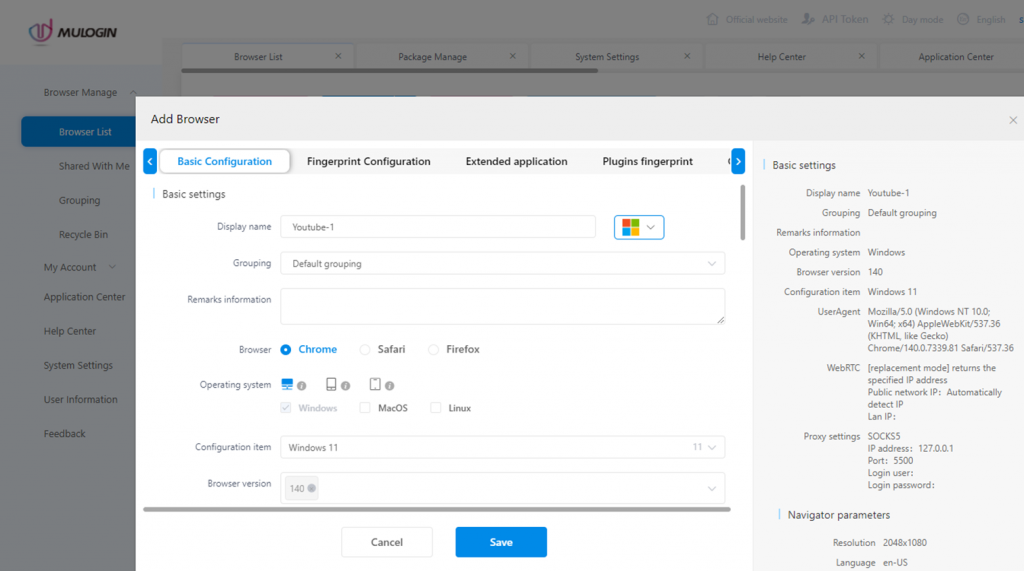
MuLogin is a professional anti-detect browser designed to solve one core problem:
👉 Creating fully isolated browser environments for each Google Ads account
You can think of it this way:
One ad account = one independent virtual device
3.1 Fingerprint-Level Isolation
Each MuLogin browser profile has its own:
- Browser fingerprint parameters
- Cookies and local storage
- Simulated system environment
- Browser cache and history
From Google’s perspective, these accounts appear to be operated by different users on different devices, rather than one person switching accounts.
3.2 Combining Proxies to Build Stable Environments
MuLogin supports all major proxy types and can be paired flexibly with:
- Residential IPs
- ISP IPs
- Country-specific fixed IPs
Common setups include:
- US ad accounts → US IPs
- European ad accounts → Matching country IPs
This alignment helps improve account credibility and reduces abnormal review triggers.
3.3 Designed for Team and Agency Workflows
In agency or team-based advertising, risk doesn’t only come from platforms — it also comes from internal operations.
MuLogin supports:
- Sub-account systems
- Granular permission control
- Traceable activity logs
Team members don’t need access to account passwords or raw cookie data. They operate only within assigned environments, significantly reducing human error and data leakage risks.
4. A Commonly Used Secure Structure for Google Ads
A widely adopted and relatively stable setup looks like this:
- 1 Google Ads account = 1 MuLogin browser profile
- Each profile is bound to 1 dedicated proxy IP
- Different clients, businesses, or regions use separate environments
- Team members access only the profiles they are responsible for
Key advantages of this structure include:
- Minimal environment overlap between accounts
- Longer account lifecycles
- Safer and more controllable scaling
5. Who Should Consider Using MuLogin for Google Ads?
MuLogin is particularly suitable if you:
- Manage multiple Google Ads accounts simultaneously
- Operate as an agency or service provider with multiple clients
- Frequently face reviews, suspensions, or account linking issues
- Work in a team environment that requires access control
- Plan to scale advertising operations long-term, not short-term testing
6. Try MuLogin with a Free Trial
For advertisers new to anti-detect browsers, the learning curve is often the main concern.
MuLogin offers a free trial so you can first experience:
- Account environment isolation for Google Ads
- Browser profile management workflows
- Proxy binding logic
- Team collaboration features
Once you confirm it fits your operation model, you can decide whether to adopt it long-term.
Conclusion: In Google Ads, Structure Matters as Much as Skill
As Google Ads becomes increasingly strict, long-term account stability depends not only on optimization skills, but also on whether you have a professional account environment architecture.
Knowing how to run ads is the starting point.
Being able to scale and sustain performance is the real barrier.
For many experienced media buyers, MuLogin has become part of the infrastructure that supports this stability.